

The invisible blueprint formed in your earliest years — and what it means for how you love, argue, trust, and connect today
You didn’t choose your first relationship. It was chosen for you — by biology, by circumstance, by whoever happened to be responsible for your care in the earliest years of your life. And yet that relationship, more than almost any other, quietly determines the template you carry into every connection that follows.
Attachment theory — first developed by psychiatrist John Bowlby in the 1960s and expanded by decades of research since — gives us one of the most powerful lenses available for understanding why we relate the way we do. Why some people pull close and others push away. Why some of us panic when a partner seems distant, and others feel suffocated when someone gets too near. Why the same dynamics keep appearing in different relationships with different people.
The answer, more often than not, begins in childhood.
What Attachment Actually Is
Attachment is not simply love or closeness. It is a biological survival system — a deep, hardwired need to maintain proximity to a protective caregiver, particularly when threatened or distressed. In infancy, this system is everything: a baby who cannot maintain connection with a caregiver cannot survive.
The crucial question that every infant is — unconsciously, neurologically — attempting to answer is: Is my caregiver available and responsive when I need them? The answer to that question, repeated across thousands of interactions in the first years of life, forms what researchers call an internal working model — a set of expectations about relationships, about whether others can be relied upon, and about whether the self is worthy of care.
These models are not consciously constructed. They are laid down at a pre-verbal level, in the body and nervous system, before language exists to name them. And they are remarkably persistent — shaping perception, expectation, and behaviour in adult relationships in ways that often feel automatic, instinctive, and simply “the way I am.”
“The question every infant is trying to answer — ‘Are you there for me when I need you?’ — becomes the question we carry, often unconsciously, into every relationship we form.”
The Four Attachment Styles
Bowlby’s colleague Mary Ainsworth identified distinct patterns of attachment behaviour in infants — patterns that researchers have since traced through adolescence and into adult relationships. The four most widely recognised styles are as follows. Most people recognise themselves in one primarily, with elements of others.
Secure Attachment
Developed when caregivers were reliably responsive — present, attuned, and able to repair ruptures in the relationship. The child learned that the world is basically safe and others can be trusted.
IN ADULT RELATIONSHIPS
Comfortable with intimacy and independence. Able to communicate needs directly, tolerate conflict without catastrophising, and return to security after disruption. Neither clingy nor avoidant — genuinely at ease with closeness.
Anxious Attachment
Developed when caregivers were inconsistently available — sometimes warm and responsive, sometimes absent or overwhelming. The child learned that love is unpredictable and must be pursued urgently.
IN ADULT RELATIONSHIPS
Preoccupied with the relationship; hypervigilant to signs of rejection or withdrawal. May seek excessive reassurance, struggle to self-soothe, or interpret neutral behaviour as threatening. Closeness is desperately wanted but rarely feels secure enough.
Avoidant Attachment
Developed when caregivers were consistently emotionally unavailable, dismissive of distress, or rejecting of dependency. The child learned to suppress attachment needs and rely only on the self.
IN ADULT RELATIONSHIPS
Values independence above intimacy; may feel uncomfortable with emotional closeness or vulnerability. Tends to withdraw under stress. Often appears self-sufficient but may struggle with genuine emotional connection and feel quietly lonely.
Disorganised Attachment
Developed when the caregiver was simultaneously the source of comfort and the source of fear — as in cases of abuse, severe neglect, or frightening parental behaviour. The child faced an unresolvable dilemma.
IN ADULT RELATIONSHIPS
Caught between longing for closeness and terror of it. Relationships feel both desperately needed and profoundly unsafe. Often associated with complex trauma; may show confusing, contradictory behaviour in moments of emotional intensity.
How These Patterns Show Up in Adult Life
Attachment styles don’t announce themselves clearly. They operate mostly beneath conscious awareness, expressing themselves through the textures of everyday relationship: how you handle conflict, how you respond when a partner is quiet or distracted, what happens in your body when someone you love seems to pull away.
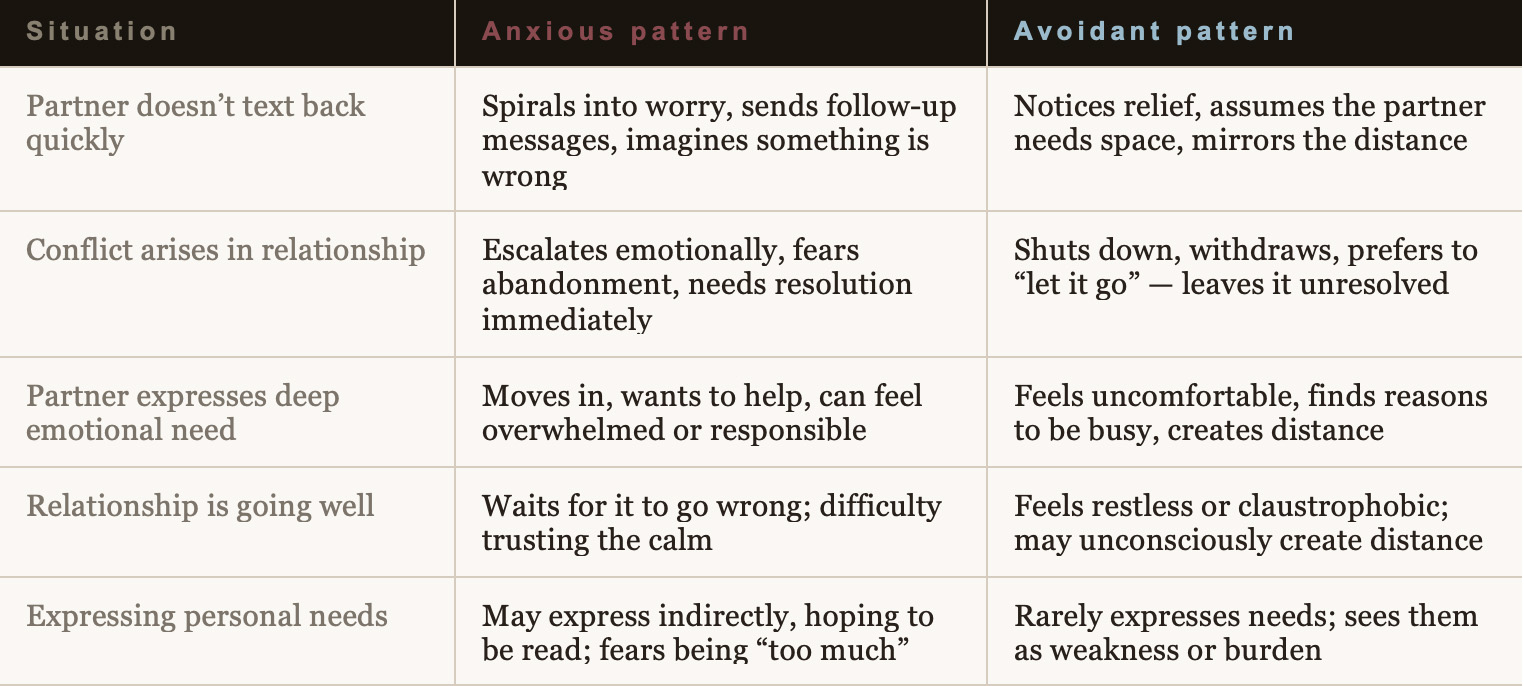
The painful irony is that anxious and avoidant attachment styles often find each other — and in doing so, each triggers the other’s worst fears. The anxious partner’s pursuit confirms the avoidant partner’s sense of suffocation. The avoidant partner’s withdrawal confirms the anxious partner’s fear of abandonment. Without understanding what’s happening, the cycle can feel like personality incompatibility, when it is really two nervous systems enacting old, learned patterns.
THE ANXIOUS–AVOIDANT TRAP
The anxious–avoidant pairing is one of the most commonly seen dynamics in couples therapy. It is rarely about the two people being wrong for each other. It is almost always about two people, both shaped by early experience, finding in each other the precise trigger for their deepest fears — and neither having the tools yet to break the cycle.
When both partners understand attachment — their own and each other’s — the dynamic can shift dramatically. What once felt like a character flaw in the other person begins to look like a wound that deserves compassion. That shift alone can change everything.
Attachment and Trauma
For many people, insecure attachment is not simply the result of “imperfect parenting” — it is the result of genuine harm. Emotional neglect, abuse, inconsistent or frightening caregiving, early loss: all of these can produce attachment disruptions that go deep into the nervous system and show up throughout life in relationships, in the body, and in sense of self.
Disorganized attachment in particular is closely associated with complex trauma — and with the kinds of interpersonal difficulties that bring people to therapy: difficulty trusting, fear of abandonment, relationships that feel simultaneously necessary and terrifying, a deep uncertainty about one’s own worth and lovability.
Working with attachment in therapy means working with these early experiences — not necessarily by revisiting every detail, but by understanding how they shaped the internal working model that is still running in the background. And then, carefully and collaboratively, updating it.
Can Attachment Style Change?
Yes. This is perhaps the most important thing to know.
Attachment style is not destiny. Research consistently shows that people move toward what is called “earned security” through meaningful relationships — including, significantly, a good therapeutic relationship. When someone experiences, repeatedly and over time, a relationship that is reliably attuned, boundaried, and repaired after rupture, the internal working model begins to update.
The therapeutic relationship is uniquely positioned to offer this. A skilled therapist provides exactly what the early caregiver could not: consistent presence, genuine attunement, honest repair when things go wrong, and a steady belief in the client’s worth that doesn’t waver under the weight of whatever the client brings.
WHAT CHANGE ACTUALLY LOOKS LIKE
Attachment work in therapy doesn’t erase early experience. It adds to it. You don’t unlearn the template — you develop the capacity to notice when it’s running, to pause before the automatic response, and to choose something different.
Over time, this changes not just how you behave in relationships but how relationships feel. The constant monitoring for threat gradually quietens. The pull to withdraw softens. Intimacy begins to feel less like a risk and more like something genuinely available to you.
That shift — from surviving relationships to genuinely inhabiting them — is one of the most meaningful changes therapy can support.
A Final Thought
Understanding your attachment style is not about assigning blame — to your caregivers or to yourself. Most caregivers did the best they could with what they had, often carrying their own unprocessed attachment wounds. The transmission of these patterns across generations is not malicious; it is, in many ways, inevitable without awareness and intervention.
What understanding attachment offers is something more useful than blame: it offers a map. A way of making sense of patterns that have felt baffling, shameful, or simply fixed. And once you have a map, you can begin to find a different route.
Your patterns make sense. And they can change.
If relationship dynamics feel stuck, confusing, or like a repeat of something older than your current relationship — therapy can help you understand why, and find a different way forward. Contact me »